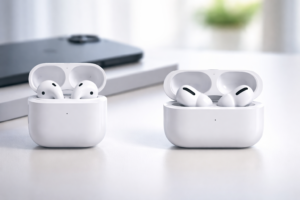
AirPods Pro 4 vs Pro 3: 7 Reasons to Wait Before You Buy
If you’re searching airpods pro 4 vs pro 3, you’re probably in the same spot as a lot of Apple fans right now: your current earbuds still work, but the next model sounds tempting. The tricky part is timing. AirPods Pro 3 is already a “buy and forget” kind of upgrade for noise cancelling, battery, and health features. Meanwhile, AirPods Pro 4 is still rumored—and the rumors are big.
So what’s the smart move? Pay for proven gains today, or wait for a model that could bring lossless audio and gesture controls? Below is a no-fluff breakdown built for shoppers in 2026 who want real reasons, not hype.
Quick Summary: Is the upgrade worth it?
AirPods Pro 3 is the safe choice if you want the best ANC, strong battery life, deeper bass, and Apple’s newest health/hearing features right now. AirPods Pro 4 is the “wait” pick if you’re excited about rumored H3 upgrades like improved ANC processing, possible lossless audio, and infrared cameras for gesture control—because those features could be a true step-change, but they are not confirmed yet.
AirPods Pro 4 vs Pro 3: What’s changing (and what’s not)
When people compare new AirPods, they often focus on one headline feature. However, your day-to-day experience usually comes down to four things: fit (seal), ANC strength, mic performance in real places, and battery.
AirPods Pro 3 already nails the fundamentals. That matters because even if Pro 4 arrives with new sensors, you’ll still wear them on trains, in meetings, and on runs. So first, here’s the practical baseline: Pro 3 is the current “max performance” option in Apple’s lineup, while Pro 4 is a premium rumor aimed at pushing the category again.
At-a-glance comparison (rumors clearly labeled)
- Noise cancelling (ANC): Pro 3 is currently the stronger real-world ANC choice thanks to the in-ear seal. Pro 4 is rumored to improve ANC further via an H3 chip.
- Battery (listening): Pro 3 leads on paper and in typical use (often cited around 6–8 hours per charge with ANC, plus about 24 hours with case). Pro 4 battery is unknown.
- Sound: Pro 3’s sealed fit helps bass and fullness. Pro 4 is rumored to aim higher (possibly lossless), but Apple hasn’t confirmed anything.
- Health/hearing features: Pro 3 stands out with heart rate and hearing-focused tools. Pro 4 may expand sensors, but that’s speculation.
- Controls: Pro 4 is rumored to add infrared cameras for gestures and spatial awareness with Vision Pro-style experiences.
- Price: Pro 3 sits in the familiar $249 tier. Pro 4 is rumored to be $299+.
- Launch timing: Pro 4 is widely rumored for late 2026, but there’s no official date.
For official current-model comparisons and specs, Apple’s tool is still the cleanest starting point: Apple’s AirPods comparison page.
1) ANC: Pro 3 wins today, Pro 4 could raise the ceiling
ANC is still the number-one “wow” feature for most upgraders. It’s also the hardest to judge from spec sheets. In real life, a sealed in-ear fit blocks noise like a soft earplug, and then ANC takes over from there. That’s why AirPods Pro models typically beat open designs in trains, planes, and busy streets.
Pro 3 is repeatedly described as Apple’s strongest ANC performer in this era, especially for voices and wind-heavy scenes. Reviews that compare Apple’s current noise-cancelling options often highlight how much the seal matters for voice isolation and consistent reduction across frequencies. For one detailed comparison focused on isolation and call performance, see: RecordingNow’s Pro 3 vs AirPods 4 ANC breakdown.
Now, here’s the part that makes Pro 4 interesting: multiple leaks claim Apple is working on an H3 chip that could push more aggressive, smarter ANC (think faster sampling and better adaptation). That could mean less “pressure,” fewer artifacts, and better cancellation for sudden sounds.
Still, it’s a gamble. Until Pro 4 ships, Pro 3 remains the pick if you want the best ANC you can buy from Apple this minute.
Real-world check: when ANC differences matter
- Daily commuting: Pro 3’s seal helps most on subways and buses, where low rumble and chatter mix together.
- Office calls: Pro 3 tends to keep your voice clearer when the room gets messy (AC noise, keyboard clatter, nearby talkers).
- Outdoor wind: Fit stability and wind handling are where “Pro” models usually justify their price.
2) Battery: Pro 3 is the safe bet if you hate charging
If you’ve ever had earbuds die during a long flight, you already know battery isn’t a “nice to have.” It’s the difference between relaxing and babysitting your charging case.
Pro 3 commonly lands around 6–8 hours of listening per charge (depending on settings), and roughly 24 hours total with the case. By comparison, Apple’s open-fit ANC earbuds tend to sit lower, often around 4–5 hours on the buds and 20 with the case. Those gaps look small on paper, but they show up fast on travel days.
Pro 4 battery life is still unknown. It could match Pro 3, or it could drop if new sensors and cameras add power draw. In other words: if battery is your pain point, Pro 3 is the “known good” upgrade.
Tip if you keep your current pair
If you decide to wait, you can stretch what you have with better habits (lower mic usage, smarter charging, and tip fit). Just don’t expect miracles from an aging battery. If you want practical ways to slow battery wear, bookmark this idea for later: prioritize partial top-ups over constant 100% charging when possible.
3) Sound: Pro 3 has the sealed-fit advantage (and it’s real)
People argue about “sound quality,” but fit is the quiet hero. With a good seal, you get stronger bass, better perceived detail, and less need to crank volume. Without a seal, bass leaks out—literally—and then the sound can feel thinner.
That’s why Pro 3 often gets described as fuller and punchier than Apple’s open-fit options. Even if you don’t call yourself an audiophile, you’ll notice it on hip-hop kicks, movie sound effects, and bass guitar.
Pro 4’s rumored ace card is lossless audio support. If Apple pulls that off in a way that works smoothly with iPhone and Apple’s ecosystem, it could be a big deal. However, “lossless on earbuds” can also be marketing if the connection, codec, and source material don’t line up.
If you want a grounded look at how Apple’s current earbuds differ in tuning, bass, and mic trade-offs, this breakdown is helpful: SoundGuys’ Pro 3 vs AirPods 4 comparison.
4) Mics and call quality: Pro 3 is the safer “work earbuds” pick
Here’s the truth: most people don’t return earbuds because of sound. They return them because calls sound bad, coworkers complain, or wind turns you into a robot.
Pro 3’s in-ear design helps in two ways. First, the seal reduces ambient noise that can confuse processing. Second, the fit tends to stay stable, so the mic system can do its job without fighting movement.
Pro 4 could improve calls if Apple uses the next chip to enhance voice separation. However, until anyone can test it in crowded cafés and windy streets, Pro 3 remains the safer bet for work and frequent calls.
5) Health and hearing features: Pro 3 already plays a different game
If you mainly use AirPods for music, health features may sound like fluff. But once you use them, they can change your routine. Pro 3’s heart rate monitoring and hearing-focused tools are especially relevant if you run, cycle, or live in loud environments.
Also, hearing tools aren’t just for older users. If you spend hours a day in earbuds, features like hearing protection and hearing checks can be a real long-term win.
Pro 4 may expand the sensor story, but Pro 3 already offers the strongest “buy it for life improvements” set today: you feel them every week, not just on launch day.
6) The big Pro 4 rumor: infrared cameras for gestures (not photos)
The most eye-catching rumor is that Pro 4 could include infrared cameras. Not for taking pictures—think motion and spatial awareness. The goal would be hands-free control (gesture volume, play/pause) and better spatial experiences with Apple’s headset ecosystem.
This idea has been reported in Apple rumor coverage, including: MacRumors’ report on AirPods Pro 4 camera rumors.
That sounds exciting, but it also raises practical questions:
- Will gestures work in real life? Your hands aren’t always in view. You’re walking, holding bags, or wearing gloves.
- Will it hurt battery? Extra sensors can mean extra drain, especially if they’re always listening or always watching.
- Will it be bulky? New hardware can change how the buds sit in the ear.
So, if gestures are the main reason you want Pro 4, the best move might be to wait until Apple shows a real demo. If you just want better ANC and daily comfort, Pro 3 already gets you there.
7) Price and timing: the “wait tax” is real
Even if Pro 4 launches late 2026, you’re paying a hidden cost by waiting: months of using older ANC, weaker battery, and fewer features. That matters if you commute daily or travel often.
Also, Pro 4 could land at $299 or more if Apple positions it as a true premium tier. If that happens, Pro 3 deals could look even better, especially around major sales periods.
On the other hand, if you upgrade every cycle and love new tech, waiting can be the smarter emotional decision. You’ll avoid buyer’s remorse if Apple ships a major redesign right after you buy Pro 3.
Upgrade decision guide (simple, no guilt)
Buy AirPods Pro 3 now if you want these upgrades today
- Top-tier ANC you can feel on commutes and flights
- Better battery for long days and travel
- Stronger bass and fuller sound from a sealed fit
- Better calls in noisy places
- Health + hearing features that you’ll actually use week to week
Wait for AirPods Pro 4 if these rumors are your must-haves
- Gesture controls that go beyond taps and squeezes
- Lossless audio (if Apple truly enables it end-to-end)
- Next-gen ANC driven by an H3-level leap
- Vision Pro-style spatial features where extra sensors may matter
Skip both upgrades if you’re in this situation
- Your current earbuds already meet your needs, and you don’t travel much.
- You mostly listen at home where ANC doesn’t matter.
- You’re waiting for a price drop and don’t mind holding out.
Background: why Pro 3 is such a strong “default” in 2026
Apple’s recent AirPods strategy looks like it’s splitting into clearer tiers. You can see this in how the lineup separates open-fit convenience from pro-grade isolation and features. Pro models win on seal-based isolation, richer bass, and advanced tools. Open-fit models win on comfort for people who hate ear tips.
Pro 3, specifically, sits in the sweet spot because it improves the core experience (ANC, battery, fit security) while also adding features that feel like “bonus devices” on your body, such as heart-rate and hearing tools.
That’s also why rumors around Pro 4 feel so bold. Apple can’t just add a slightly better chip and call it a day. To convince Pro 3 owners, it needs something you’ll miss if you don’t have it—hence gestures, sensors, and lossless talk.
For another perspective on how Apple’s noise-cancelling earbuds differ in design, case size, and features, this overview is useful: What Hi-Fi?’s AirPods noise-cancelling comparison.
Expert perspectives: the “buy now” camp vs the “wait” camp
Viewpoint A: “Buy Pro 3—rumors don’t help your commute”
This camp treats earbuds like shoes: if you use them daily, comfort and performance today matter more than speculative features later. They also point out a simple truth: new hardware sometimes introduces first-gen bugs. So, buying a mature product can be the calmer choice.
Viewpoint B: “Wait—Pro 4 could be the first real leap since the H2 era”
The other camp looks at the rumored package (H3 + sensors + gestures) and sees a bigger platform shift. If Apple ties Pro 4 into its headset and on-device AI features, the earbuds could become more like wearable controllers than just audio devices.
Both views are reasonable. The best choice depends on how much you value certainty versus novelty.
What happens next (and what to watch)
Until Apple confirms anything, treat Pro 4 details as “interesting, not guaranteed.” Still, you can watch for three signals that Pro 4 is truly worth holding out for:
- Clear lossless plan: Not just a buzzword—Apple needs a straightforward way for normal users to benefit.
- Gesture demo in the real world: Gestures need to work while walking, commuting, and working out.
- No battery penalty: New sensors should not cut listening time in a noticeable way.
If those boxes get checked, Pro 4 could be the “skip a generation” kind of upgrade. If not, Pro 3 stays the smarter buy for most people.
FAQs
Is AirPods Pro 4 real or just rumors?
Right now, it’s still rumors. Several reports point to a late-2026 window and new sensors, but Apple hasn’t confirmed a product or date.
How much better is AirPods Pro 3 ANC than other AirPods?
Pro 3’s sealed in-ear fit is the key advantage. It blocks more noise before ANC even starts, so it tends to win in trains, planes, and busy streets.
Should I upgrade from Pro 2 to Pro 3 or wait for Pro 4?
If you want noticeably better ANC, battery, and newer health/hearing features now, Pro 3 is a strong upgrade. If you mainly want rumored gesture controls or lossless audio, waiting for Pro 4 may make more sense.
Does Pro 3 battery last longer with ANC on?
Yes, Pro 3 generally leads on listening time with ANC compared with Apple’s open-fit ANC options. Exact hours vary by settings and volume.
What are the rumored Pro 4 cameras for?
They’re rumored to be infrared sensors for gesture control and spatial awareness, not photo cameras. Think “control and context,” not “pictures.”
Is Pro 3 worth the higher price over cheaper AirPods?
If you care about strong ANC, bass, calls, and health/hearing features, yes. If you hate ear tips and want light comfort above all, you may prefer an open-fit model instead.
Should I buy Pro 3 now or wait for Pro 4 pricing?
Buy Pro 3 now if you’ll use the benefits daily and your current earbuds annoy you. Wait if you’re happy today and you only upgrade for major new features.
Conclusion: the practical answer for most buyers
If you want the simplest recommendation: AirPods Pro 3 is the best “upgrade you’ll feel immediately.” It improves the stuff you deal with every day—noise, calls, battery, and fit. Meanwhile, AirPods Pro 4 could be a bigger leap, but it’s still unconfirmed, and new sensors could come with trade-offs.
If you know your current earbuds are holding you back, upgrading to Pro 3 is unlikely to disappoint. However, if you love early-adopter features and you’re specifically excited about gestures or lossless, waiting could save you from instant regret.
Share this with someone who’s stuck in upgrade limbo. Also, what’s your take—would you pay extra for gesture controls on earbuds, or do you just want better ANC? Drop a comment below, and subscribe to stay informed as Pro 4 leaks (and confirmations) land.