Meta description: Learn an authentic Gujarati mohanthal recipe — step-by-step halwai method, one-thread sugar syrup guide, and tips for a danedar (grainy) texture perfect for Janmashtami or Diwali. Easy, festival-ready besan mohanthal you can make at home.
Meta description: Includes exact measurements, troubleshooting, storage tips, and a short video demo.
Mohanthal Recipe: How to Make Authentic Gujarati Mohanthal at Home
Introduction
Janmashtami and Diwali call for sweets that feel like home — and a classic Gujarati mohanthal fits the bill. In this mohanthal recipe you’ll learn the authentic halwai method to get a danedar (grainy) texture, how to make the perfect one-thread sugar syrup, and quick troubleshooting so your mithai turns out right every time.
Prep time: 10 minutes | Cook time: 30–40 minutes | Yield: 12–16 pieces
Key takeaways: this is a ghee-forward sweet; bind besan with hot milk and ghee, roast low until aromatic, and use one-thread sugar syrup to set. The result is rich, slightly grainy, halwai-style mohanthal perfect for festivals.
Featured Snippet
Mohanthal is a traditional Gujarati sweet made from roasted gram flour, ghee, sugar syrup and milk (optional saffron/cardamom). To make it: bind besan with hot milk and ghee, roast until aromatic, mix with one-thread sugar syrup, press into a tray, garnish, and cut once set — for a danedar, grainy texture roast low and sieve first.
What is Mohanthal?
Origin & festive significance
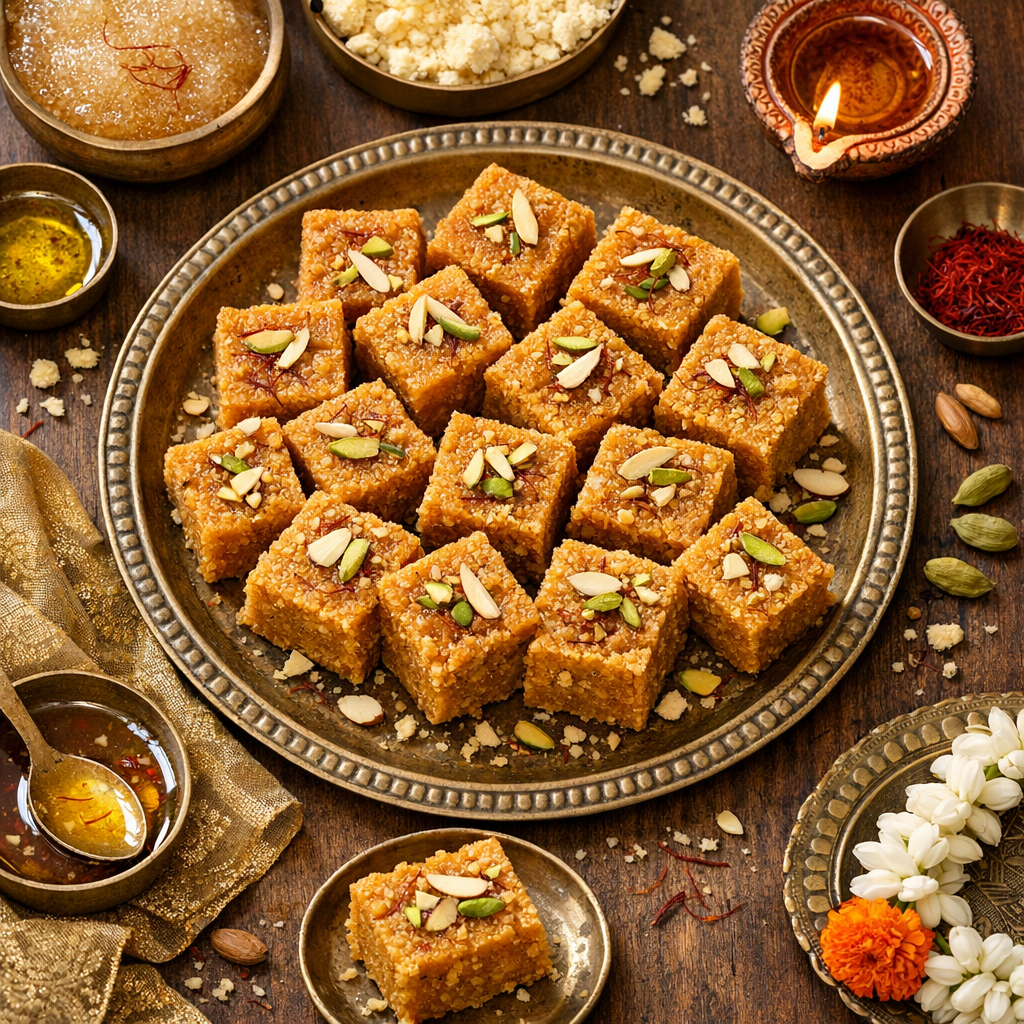
Mohanthal is a traditional Gujarati sweet (mohanthal mithai) often prepared for religious festivals like Janmashtami and Diwali. It’s rooted in Gujarati halwai kitchens and celebrated for its rich ghee flavor, saffron aroma, and slightly grainy texture that melts on the tongue.
Difference vs. besan barfi & when to choose mohanthal
Both use besan (gram flour) and ghee, but besan barfi is typically smooth and dense. Mohanthal is intentionally grainy (danedar) because of a different binding and roasting technique. Choose mohanthal when you want a halwai-style, rustic, melt-in-mouth texture with visible besan granules.
Ingredients for Mohanthal
For binding the besan
- Besan / Gram flour — 2 cups / 250 g
- Hot milk — 3 tbsp
- Ghee (for binding) — 3 tbsp
For roasting & mixing
- Ghee for roasting — 200 g (melted, clarified)
- Milk for mixing — 1/2 cup (6 tbsp)
For sugar syrup
- Sugar — 1 cup (200 g)
- Water — 1 cup (240 ml)
- Saffron strands — a pinch (optional)
- Optional: crushed green cardamom — 4–5 pods
Garnish & optional add-ins
- Slivered almonds and pistachios — 2–3 tbsp
- Edible silver (varq) — optional
- Khoya (reduced milk solids) — 50–100 g for richer mohanthal (optional)
Tools & prep notes
- Heavy-bottomed pan or kadai — for even heat during roasting.
- Flat non-stick or stainless skillet for better control.
- Wooden spatula or heatproof silicone spatula — for steady stirring.
- 8×8 inch (20 x 20 cm) tray or square tin for setting.
- Fine sieve — pre-sift the besan for even texture (helps danedar outcome).
- Thermometer (optional) — sugar syrup 106–110°C for one-thread stage.
Prep tip: Sift the besan once, then rub it with hot milk and ghee (see Step 1). You can pre-roast a little if you want, but the halwai method roasts the mohanthal mix slowly in ghee for authentic flavor.
Step-by-Step Mohanthal Recipe
Step 1: Mix besan with hot milk & ghee
Measure 250 g besan into a bowl. Add 3 tbsp hot milk and 3 tbsp ghee. Using your fingertips, rub the mixture gently until slightly lump-free and aromatic. This “rub” method helps coat the flour in fat and moisture, preventing lumps and encouraging the grainy texture.
Step 2: Rest & sieve
Let the rubbed mixture rest for 5–10 minutes. Then pass it through a fine sieve into another bowl to remove any remaining lumps and ensure an even, danedar crumb once roasted.
Step 3: Roast the besan mixture in ghee
Heat 200 g melted ghee in a heavy-bottomed pan on low-medium heat. Add the sieved besan mixture and roast on low heat, stirring constantly. Keep the flame low to prevent burning. Roast for 20–25 minutes — you’ll see light brown specks, the aroma will turn buttery and nutty, and the raw smell disappears. The color should be a warm golden-brown, not dark brown.
Step 4: Prepare 1-thread sugar syrup
In a separate saucepan, combine 1 cup sugar and 1 cup water. Add saffron strands and crushed cardamom if using. Bring to a boil, skim foam, then simmer. Test for one-thread stage: take a little syrup between forefinger and thumb and pull apart — a thin single thread should form. If using a thermometer, aim for ~106–110°C (223–230°F).
Step 5: Combine syrup and roasted besan
Once the roasted besan is hot and aromatic, reduce heat to very low. Slowly pour the hot one-thread sugar syrup into the roasted besan while stirring continuously. Pour in a thin stream and stir briskly but gently — you want even absorption without making it soggy. Add the remaining 1/2 cup milk if the mix feels dry. Taste and add saffron or cardamom now. The mixture should come together but still retain a slightly grainy texture.
Step 6: Set, garnish & cut
Grease the tray with a little ghee, then transfer the hot mixture into it. Level with a spatula, press firmly, and top with slivered nuts and varq. Allow to cool at room temperature for 2–4 hours (1–2 hours in fridge). For clean cuts, chill slightly before cutting and use a sharp knife greased with ghee.
Troubleshooting & “Why it went wrong”
| Problem | Likely cause | Fix |
|---|---|---|
| Mohanthal too soft / not setting | Syrup undercooked (too thin) or too much milk/ghee | Reheat mixture, add a little more cooked sugar syrup (one-thread) or roast longer to remove moisture; reduce milk next time. |
| Mohanthal too hard / chewy | Sugar syrup overcooked (two-thread or ball stage) or over-roasted besan | Avoid overcooking syrup; if done, try adding warm milk-butter mix to soften slightly, or make smaller batch next time. |
| Not grainy (too smooth) | Over-sieving or over-mixing; too much milk created paste | Use less milk and perform light sieving only; rub and roast as instructed for danedar texture. |
| Greasy / oozing ghee | Too much ghee or insufficient roasting to absorb fat | Roast longer so besan absorbs ghee; use correct ghee-to-besan ratio (about 200 g ghee for 250 g besan overall). |
| Sugar syrup crystallized | Impurities, sudden stirring, or low heat | Bring back to boil, add a few drops of lemon juice, and reheat to one-thread; strain if necessary. |
Tips & Tricks for Perfect Mohanthal
How to get the danedar/grainy texture
Rub besan with hot milk and ghee, sieve lightly, then roast slowly. Don’t over-smooth the mix. Light sieving removes lumps but keeps granules that create danedar texture.
Sugar syrup consistency cues & alternatives
One-thread syrup is the goal — test with fingers (pull-apart thin thread) or use a thermometer (~106–110°C). If you prefer, small batches can be tested using a cold plate test.
Best ghee-to-besan ratio & pan choice
Use about 200 g ghee for 250 g besan total (including the ghee used for rubbing). A heavy-bottomed pan prevents hot spots and burning.
Aroma & color checkpoints
When roasting, watch for a nutty, buttery aroma and warm golden-brown flecks. If it smells burnt, discard and start again; burnt flavor is hard to fix.
Scaling the recipe for larger batches
Scale ingredients proportionally. Roast in a wider pan to maintain low heat and stir more often to avoid uneven browning. Large batches may take longer to set.
Variations
Mohanthal with khoya
Add 50–100 g homemade or store-bought khoya to the roasted besan before adding syrup for richer, creamier mohanthal. Reduce milk accordingly.
Mohanthal without khoya
Traditional mohanthal often skips khoya. Follow the base recipe for a classic besan mohanthal that’s lighter yet rich from ghee.
Halwai-style danedar mohanthal
Follow the full rub, sieve, and long-roast method. Use pure ghee and low heat — halwai-style relies on patience and constant stirring to get the signature grainy texture.
Quick mohanthal (skipping long roast; pros/cons)
Shorten roasting time and use higher heat — saves time but risks a less developed flavor and possible greasy texture. Only use for small, quick batches.
Nutty / Chocolate fusion variations
Fold in finely chopped roasted nuts or a tablespoon of cocoa powder for a modern twist. Keep proportions small so texture remains balanced.
Serving Suggestions & Festival Uses
Serve mohanthal at Janmashtami, Diwali, or as part of a sweet platter. Pair with strong masala chai, cardamom tea, or alongside other sweets like ladoos and barfi. For offerings, place a few pieces on a clean plate with a saffron strand or edible varq for a festive touch.
Storage & Shelf Life
Room temperature storage
Store in an airtight container in a cool, dry place for 4–5 days. In cool weather the texture stays stable; avoid humid conditions.
Refrigeration & long-term storage
Refrigerate in an airtight box for up to 2 weeks. Bring to room temperature before serving — this restores softness. For best texture, remove from fridge 30–60 minutes before serving.
Freezing?
Freeze pieces wrapped individually in parchment and sealed in a freezer-safe bag for up to 2 months. Thaw in fridge overnight and bring to room temperature before serving — texture may slightly change but flavor holds.
FAQ
What is Mohanthal made of?
Gram flour (besan), ghee, sugar (syrup), milk; saffron/cardamom and nuts for flavour.
How do you make Mohanthal soft and grainy (danedar)?
Rub besan with hot milk & ghee, sieve lightly, roast low until aromatic; proper roast + light sieving gives grainy texture.
What is the right sugar syrup consistency for Mohanthal?
One-thread (single-thread) syrup — when a thin thread forms between two fingers; thermometer ~106–110°C if used.
Can Mohanthal be made without khoya?
Yes — traditional recipes use only besan and ghee; khoya is an optional richer variation.
Why is my Mohanthal hard?
Likely overcooked sugar syrup (too hard) or over-roasting. Use one-thread syrup and avoid two-thread/ball stages; roast till aromatic, not dark.
How long does Mohanthal take to set?
Room temperature: 2–4 hours depending on climate; refrigeration speeds it to 1–2 hours.
Can I store Mohanthal at room temperature?
Yes — in airtight container for 4–5 days in cool weather; refrigerate in warm/humid climates for up to 2 weeks.
Is Mohanthal the same as besan barfi?
Similar base ingredients but different texture and method — mohanthal is grainy and halwai-style; barfi is smoother and denser.
Recipe Card
Title: Mohanthal Recipe (Authentic Gujarati)
Serves: 3–4 | Prep: 10 min | Cook: 30–40 min
Ingredients (concise)
- Besan — 2 cups / 250 g
- Ghee — 200 g + 3 tbsp for rubbing
- Hot milk — 3 tbsp (for rub) + 1/2 cup (6 tbsp) for mixing
- Sugar — 1 cup
- Water — 1 cup
- Saffron, cardamom, nuts to taste
Steps (condensed)
- Rub besan with 3 tbsp hot milk & 3 tbsp ghee. Rest & sieve.
- Roast sieved besan in 200 g ghee on low for 20–25 minutes till aromatic.
- Make one-thread sugar syrup (1 cup sugar + 1 cup water, ~106–110°C).
- Mix syrup into hot besan, add 1/2 cup milk if needed. Stir to combine.
- Press into greased tray, garnish, cool 2–4 hours, cut and serve.
Nutrition estimate (per piece, approximate): 150–200 kcal depending on size and ghee used.
Visual & UX recommendations
- Include photos at each major step: mixed besan, roasting stage, one-thread syrup, pouring syrup, set block, cut pieces.
- Embed a short YouTube clip and include a 20–30 word transcript snippet below it to increase dwell time.
- Quick tips box near the top for snippet eligibility: “Rub besan with hot milk & ghee, roast low, use one-thread syrup.”
- Use recipe schema markup for the recipe card, ingredients, and steps.
You can also watch the full recipe video below
Conclusion
Mohanthal is a comforting, halwai-style Gujarati sweet that shines on festival days. With the rub method, slow roasting, and a proper one-thread syrup, you’ll get that authentic danedar texture every time. Try this mohanthal recipe for your next Janmashtami or Diwali platter — and if you liked this guide, check out our besan barfi recipe and sugar syrup guide next.
Enjoy making and sharing this classic — and let me know how your batch turned out!