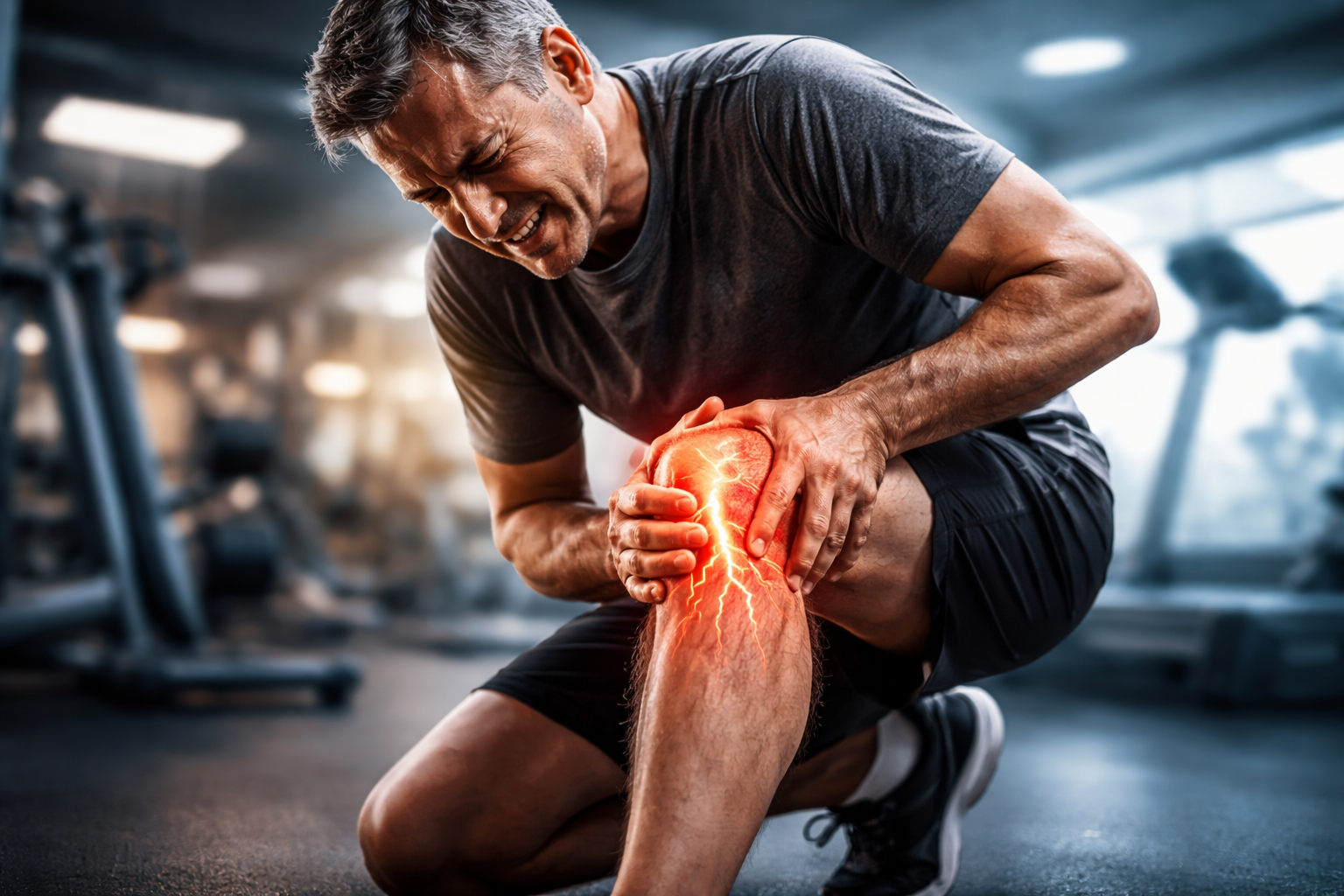
Knee Pain After Exercise Explained: 7 Fixes at 45+
Knee pain after exercise can feel unfair, especially if you’ve stayed active for years. One week you’re fine, and the next you’re stiff walking downstairs after leg day or a run. So what changed?
Often, it’s not “getting old.” It’s workload, recovery time, form, and small imbalances that start to matter more after 45. The good news is that most post-workout knee pain improves when you adjust a few controllable things—before it turns into a real setback.
Quick summary (read this if you’re in a hurry)
Knee pain after exercise usually comes from either normal post-workout soreness (DOMS) or an early overuse pattern caused by doing too much too soon, poor mechanics, or weak hips/feet. If your discomfort peaks 24–48 hours later and fades in 3–5 days, it’s often normal. If it keeps getting sharper, more localized, or lasts past a week, treat it as a warning and modify your training.
First, is it normal soreness—or an injury building?
A simple decision check you can use today
- If it’s likely DOMS (normal): soreness starts 24–48 hours after a new or harder workout, feels more like muscle tenderness around the knee, and improves with light movement. It usually resolves in 3–5 days. A medical overview of this pattern appears in this DOMS and post-workout knee discomfort guide.
- If it’s likely overuse: pain feels more specific (front of kneecap, inner joint line, outside knee), returns during the same exercise, and trends worse across sessions.
- If it’s likely an acute injury: you felt a clear “moment” (pop, twist, buckle), swelling appears within hours, or the knee feels unstable.
Meanwhile, don’t ignore “small” pain that keeps showing up. Overuse injuries often start as mild post-workout discomfort, then slowly claim more of your week.
When to stop guessing and get checked
- Swelling, warmth, or redness around the knee
- Locking, catching, or giving way
- Pain that changes your walking
- Pain that persists beyond 2 weeks despite smart modifications
Why your knees hurt after workouts: the 7 most common causes
1) You did “too much too soon” (the #1 trigger after 45)
This is the classic setup: you feel good, so you add weight and reps and frequency. Your muscles may keep up, but your tendons, cartilage, and joint surfaces adapt more slowly—especially as recovery slows with age.
For example, jumping your leg press from 25 lbs to 50 lbs, doubling squat reps, or adding hill sprints in week one often overloads tissue capacity. As a result, the knee becomes the “alarm system,” even if the real issue is total load.
- Fix: increase either intensity or volume—not both—by about 10% per week.
- Also: keep one “easy” lower-body day between harder sessions.
2) DOMS feels like knee pain (even when your knee joint is fine)
DOMS can show up as stiffness around the knee because the quads, calves, hamstrings, and even the small stabilizers get sore. Then, when you go downstairs, it feels like the knee itself is the problem.
However, DOMS should trend better each day, not worse. It should also loosen up after a warm shower or a short walk.
- Fix: do light movement for circulation (easy bike, brisk walk, gentle mobility), hydrate, and sleep.
- Avoid: “testing” the knee with heavy squats the day it feels stiff.
3) Weak hips shift stress into your knees
This surprises people, but it’s common: weak glutes (especially the glute medius on the side of your hip) let your thigh rotate inward. Then your knee collapses inward during squats, stairs, or running.
Over time, that pattern can irritate the kneecap area and the inner knee. Importantly, it often shows up only when you get tired—so your first few sets look fine, and the last sets look messy.
- Fix: add 2–3 sets of simple hip stability work, 2–3 times per week: clamshells, side-steps with a band, and single-leg stands.
- Quick test: film a bodyweight squat. If your knees drift inward, treat hips as a priority.
4) Foot and ankle issues (the “hidden source”)
Your knee sits between your foot and your hip. So if your foot overpronates, your arch collapses, or your ankle is stiff, your knee often pays the price.
Worn-out shoes can quietly change your mechanics. In addition, footwear that doesn’t match your activity (lifting vs. running) can increase knee stress without you noticing day to day.
- Fix: replace running shoes around 300–500 miles (many people need it sooner than they think).
- Also: try ankle mobility (knee-to-wall drill) and basic foot strength (short-foot holds).
5) Form breakdown during “knee-heavy” gym moves
Squats, lunges, step-ups, leg press, and leg extensions all load the knee. That’s not bad—knees are built to load. But small form errors can turn normal load into irritation.
- Common squat/lunge issues: knees collapse inward, heels lift, you dive too deep without control, or you bounce out of the bottom.
- Common leg press issue: going too deep so your pelvis tucks, then the knee angle gets extreme.
- Common leg extension issue: going heavy with force at the ankles, which can feel rough on the front of the knee for some people.
Fix: reduce range of motion temporarily, slow the lowering phase, and keep reps smooth. If the knee calms down, rebuild depth and load gradually.
6) Running errors: overstriding, hills, and “too many hard days”
Runners often feel knee pain after exercise because running repeats the same motion thousands of times. If your stride reaches too far in front (overstriding), your knee takes a bigger braking force. Then hills and speed work add even more stress.
“Runner’s knee” (often pain around the kneecap) is one of the most common overuse injuries. Temple Health notes how frequently it shows up and why it happens in this orthopedic overview of common running knee injuries.
- Fix: keep easy runs truly easy, add hills slowly, and consider a small cadence increase (shorter steps) to reduce braking.
- Rule of thumb: don’t add mileage and speed in the same week.
7) Osteoarthritis flare-ups (activity can trigger symptoms)
After 45, more people have some cartilage wear—even if they’ve never been diagnosed. Activity doesn’t automatically “cause” osteoarthritis, but hard or unfamiliar training can trigger symptoms in an already sensitive joint.
If you suspect this, focus on consistency over intensity. Hospital for Special Surgery breaks down common causes and next steps in this knee pain after running resource.
- Fix: prioritize low-impact conditioning (cycling, incline walking, swimming) while you rebuild leg strength.
- Also: use pain as a dial, not a stop sign. Aim for “mild discomfort” at most, not sharp pain.
Workout knee injury causes: gym vs. running (what changes?)
If your knee pain shows up after the gym
Gym-related knee pain often comes from load jumps, deep angles under fatigue, or single exercises that irritate the joint (like heavy leg extensions for some people). The upside is you can usually fix it quickly by adjusting range of motion, tempo, and weekly volume.
- Most common pattern: front-of-knee pain after squats, lunges, or leg press
- Most common root causes: poor knee tracking, weak glutes, too much too soon
If your knee pain shows up after running
Running stacks small forces for long periods. So even “tiny” issues—shoe wear, hip weakness, a sudden hill week—can show up as pain after exercise.
- Most common pattern: kneecap-area pain that worsens during or after runs
- Most common root causes: sudden mileage change, hills/speed, overstriding, hip control
Prevent knee pain gym and running: 7 fixes ranked by impact
Fix #1: Control your weekly load (highest impact)
If you do nothing else, do this. Track what you did last week, then increase slowly. After 45, that isn’t “playing it safe”—it’s how you keep training year-round.
- Increase weekly running mileage by about 10% or less
- On strength work, add either 5–10% weight or 1–2 sets—not both
- Keep at least one lower-body day “sub-max” (easy-ish) each week
Fix #2: Warm up like you mean it (especially after 45)
Warm tissue handles load better. Cold tissue complains. So a short warm-up can prevent a long recovery.
- 5 minutes: brisk walk or easy bike
- 2 minutes: ankle rocks, leg swings, bodyweight squats to a box
- Then: do two lighter “ramp-up” sets before your working sets
Fix #3: Strengthen the hips and hamstrings (knee-friendly armor)
Strong hips keep the knee tracking well. Strong hamstrings help balance quad dominance, which can reduce front-of-knee irritation in many lifters and runners.
- Great options: Romanian deadlifts (light to moderate), hip hinges, glute bridges, step-ups
- Simple band circuit: lateral steps + clamshells + monster walks
Fix #4: Clean up your squat and lunge mechanics
Most people don’t need to “stop squatting.” They need to squat in a way their knees tolerate.
- Use a box: squat to a box to control depth
- Slow down: 2–3 seconds down, controlled up
- Watch tracking: knees roughly follow the line of your toes
Fix #5: Use smarter cardio swaps during flare-ups
If your knee pain after exercise spikes, you don’t have to quit training. Instead, change the stress.
- Swap running for cycling or pool work for 1–2 weeks
- Swap jumping for sled pushes, carries, or incline walking
- Keep strength work, but reduce knee-bending volume temporarily
For broader guidance on managing persistent knee discomfort, Harvard Health offers practical options in this knee pain management resource.
Fix #6: Check your shoes and surfaces
Sometimes the “program” is fine, but your shoes are cooked. Or you switched from treadmill to concrete sidewalks and your knees noticed immediately.
- Replace worn running shoes and rotate pairs if you run often
- Use stable lifting shoes (or flat, firm soles) for strength sessions
- Avoid sudden surface changes when you increase training load
Fix #7: Recover like an adult (sleep, spacing, and simple joint recovery tips)
Recovery isn’t lazy. It’s the part that lets your joints adapt.
- Sleep: aim for consistent bed and wake times
- Spacing: avoid stacking two hard knee-heavy days back to back
- After tough sessions: 10–15 minutes easy walking can reduce stiffness
- Self-care tools (optional): foam rolling quads/calves and light stretching can help you move better, even if it doesn’t “fix” the root cause
If you want a simple public-health checklist for running injury prevention, the NHS summarizes common causes and prevention steps in this knee pain and running injuries guide.
Background: why knee issues show up more after 45
Three things usually change with age, even for active people. First, you lose some “buffer” because tissues recover more slowly. Second, you may sit more than you used to, which can tighten hips and ankles. Third, you might train in bursts—hard for a few weeks, then off—so your knees never get steady adaptation.
However, none of that means you should stop. It just means your best plan looks more like consistency than hero workouts.
Expert perspectives and multiple viewpoints (what clinicians often see)
Sports medicine view: Most knee pain after exercise starts as load management. When people reduce spikes in training and improve mechanics, symptoms often settle without major intervention.
Physical therapy view: The knee frequently acts like a “middleman.” Therapists often look at hip control and ankle mobility first, because fixing those reduces knee stress during squats and running.
Ortho view: If swelling, locking, instability, or a clear injury event shows up, imaging may matter. That’s when you stop experimenting and get a real exam.
What happens next: a 2-week plan to calm your knees without losing fitness
- Days 1–3: reduce aggravating moves (deep knee bends, hills, jumps). Keep moving daily with easy walking or cycling.
- Days 4–7: reintroduce strength with controlled range (box squats, step-ups). Keep reps smooth and stop 2–3 reps before failure.
- Week 2: add load slowly (one change at a time). If pain stays mild and trends down, continue.
Most importantly, judge progress by trend, not one session. If the pain shrinks week to week, you’re on the right track.
FAQs
How long does normal knee soreness last after a workout?
DOMS often starts 24–48 hours after exercise and improves within 3–5 days. If pain lasts beyond a week or worsens with the same activity, treat it as overuse and modify.
Should I rest completely or keep exercising if my knees hurt?
Usually, keep moving but change the stress. Avoid the painful exercise for now, and use low-impact options like cycling or swimming while symptoms settle.
Can I still do squats if I have knee pain?
Often yes, but adjust depth, tempo, and load. Many people do better with box squats, slower lowering, and fewer total sets until irritation calms down.
What’s the safest way to increase intensity without hurting my knees?
Change one variable at a time and aim for about a 10% weekly increase. For example, add a small amount of weight or an extra set—not both in the same week.
Are my old running shoes causing my knee pain after exercise?
They can. Worn shoes lose cushioning and support, which can change how force travels up your leg. If your shoes are near 300–500 miles, replacement is worth considering.
Do weak hips really affect my knees?
Yes. Weak hip stabilizers can let the knee drift inward during squats or running, increasing stress on the kneecap and inner knee.
When should I see a doctor or physical therapist?
Go if you have swelling, instability, locking, a clear injury moment, or pain that persists beyond 2 weeks despite smart changes.
Conclusion: keep training—just train smarter
Knee pain after exercise doesn’t have to be your new normal after 45. In many cases, the fix is boring but powerful: smaller load jumps, better warm-ups, stronger hips, and enough recovery to let your joints adapt.
If this helped, share it with someone who’s frustrated by knee pain. Also, what activity triggers your symptoms most—squats, stairs, or running? Drop a comment with what you’re noticing, and bookmark this page so you can revisit the 2-week reset plan.